
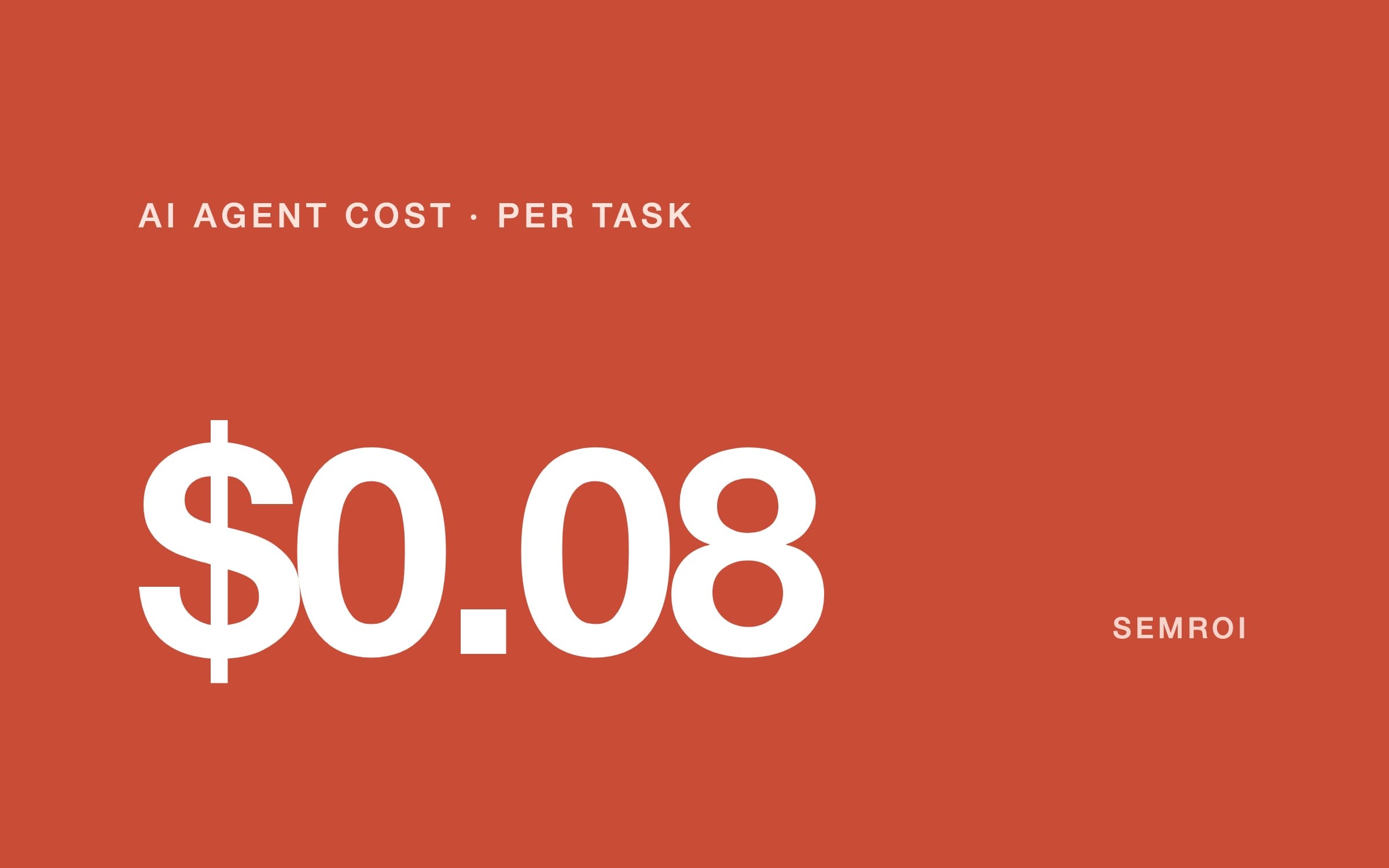
Short answer. A custom AI agent costs three things: the build (mostly the harness and the integrations around the model, not the model), the run (tokens per task times tasks, plus hosting) and the upkeep (model and price changes, evals, monitoring). Quotes online range from about $5K to $800K+ because they price the agent type. Price the work instead: count the tools it must call, the approvals it needs, the languages it speaks and the tasks it will run each month.
Why AI agent quotes range from $5K to $800K
Search for the cost of an AI agent and the first page is agency price tables. One lists rule-based bots at $15K–40K and enterprise agents at $300K–800K+; another puts a task agent at $50K–120K and a multi-agent system at $150K–400K+; a third starts at $2,500. Most of them still quote GPT-4-era token prices, and few show a single calculation.
The tables are not wrong, they are just priced by label. "Multi-agent" or "RAG agent" says little about the work. Two agents with the same label can differ ten times in cost because one reads a single database and the other writes to a CRM, an ERP and a payment system, with an approval step before every write. So below we break the price into the parts you can count.
The three parts of the bill
- Part: BuildWhat you pay for: Harness, tool integrations, knowledge prep, evals, approvals, UI or channelWhat makes it go up: Number of systems it writes to, approval rules, languages, complianceWhen you pay: Once, at the start
- Part: RunWhat you pay for: Model tokens per task, tool and search fees, hosting, vector storeWhat makes it go up: Steps per task, context size, model tier, no caching, volumeWhen you pay: Every month, per task
- Part: UpkeepWhat you pay for: Model and price changes, eval re-runs, monitoring, fixesWhat makes it go up: Fast-moving models, many integrations, no eval setWhen you pay: Every month, often forgotten
| Part | What you pay for | What makes it go up | When you pay |
|---|---|---|---|
| Build | Harness, tool integrations, knowledge prep, evals, approvals, UI or channel | Number of systems it writes to, approval rules, languages, compliance | Once, at the start |
| Run | Model tokens per task, tool and search fees, hosting, vector store | Steps per task, context size, model tier, no caching, volume | Every month, per task |
| Upkeep | Model and price changes, eval re-runs, monitoring, fixes | Fast-moving models, many integrations, no eval set | Every month, often forgotten |
Build cost: you pay for the harness, not the model
The model is rented by the token. What you build is everything around it: the loop that lets it call tools, the context it is given, the rules on what it may do, the checks that catch mistakes. That code is the agent harness, and it is where the build hours go. The factors that move it:
- Tools and integrations. Each system the agent reads from or writes to is its own piece of work: auth, error handling, rate limits, tests. Read-only access is cheap; writes need more care. This is usually the largest line.
- Permissions and approvals. Which actions run on their own, which wait for a person, what is logged. A refund over a limit, a price change, a delete: each rule is code, not a sentence in a prompt.
- Knowledge. If answers come from your documents, someone has to clean, chunk and index them, then keep them fresh. See RAG for how that works.
- Evals. A set of real tasks with known good answers, run before launch and after every change. Without it you cannot tell whether a new model or prompt made things better or worse.
- Languages and markets. Every extra language needs its own test set, tone rules and localized data.
- Channel. A Slack bot, a WhatsApp number, a widget on your site or an MCP server your team uses from Claude: each has its own setup and limits.
- Security and compliance. Prompt-injection defences, data handling, and in the EU the duty to tell users they are talking to an AI.
A useful way to scope: write down every action the agent may take, mark each as read or write, and mark which writes need approval. That list predicts the build better than any label. If the list is short and the steps are fixed, you may not need an agent at all: a workflow tool such as n8n can be cheaper.
Run cost: work it out per task
Run cost is where most estimates guess. You do not need to guess: an agent task is a series of model calls, and each call has a size. Anthropic measured that agents typically use about 4x more tokens than chat interactions, and multi-agent systems about 15x more. The reason is that every step sends the whole context again: the instructions, the tool definitions and everything the agent has seen so far.
Here is a worked example for a support agent that answers an order question in five steps (read the message, look up the order, check the policy, check stock, reply). Assumptions: an 8,000-token fixed prefix (system prompt, policy, tool definitions), about 1,500 tokens of tool results added per step, 400 output tokens per call. That is 57,500 input and 2,000 output tokens per task.
- Setup: Claude Sonnet 5.5, no caching ($2 / $10 per MTok)Per task: $0.135Per 10,000 tasks / month: $1,350
- Setup: Claude Sonnet 5.5, fixed prefix cachedPer task: $0.078Per 10,000 tasks / month: $782
- Setup: Claude Haiku 5.5, no caching ($0.10 / $0.50 per MTok)Per task: $0.007Per 10,000 tasks / month: $68
| Setup | Per task | Per 10,000 tasks / month |
|---|---|---|
| Claude Sonnet 5.5, no caching ($2 / $10 per MTok) | $0.135 | $1,350 |
| Claude Sonnet 5.5, fixed prefix cached | $0.078 | $782 |
| Claude Haiku 5.5, no caching ($0.10 / $0.50 per MTok) | $0.007 | $68 |
Three things follow. First, the model tier matters more than anything else: the same task is twenty times cheaper on a small model, so route easy steps to it and keep the large model for the hard ones. Second, caching the fixed prefix cuts the bill by about 40% here. Third, the number of steps drives everything: a task that takes ten steps instead of five more than doubles the cost, because each step resends a longer history.
Run 20 real tasks through a prototype, log input and output tokens per call, and multiply by your monthly volume. That number beats any table, ours included.
Add the smaller items: web search is $10 per 1,000 searches on Anthropic’s API, hosting and a vector store are usually tens to a few hundred dollars a month at small-business volume, and the Batch API halves token prices for work that can wait.
Upkeep: the line that sinks projects
Gartner predicted in June 2025 that over 40% of agentic AI projects will be canceled by the end of 2027, due to escalating costs, unclear business value or inadequate risk controls. Much of that cost arrives after launch:
- Prices move. Google’s Gemini 4 Carbon costs $2 / $10 per MTok until 30 November 2026 and $4 / $20 from 1 December. Your run cost can double with no change on your side.
- Models retire and tokenizers change. Anthropic notes that its newer tokenizer produces about 30% more tokens for the same text. A model swap means re-running your evals and checking the bill.
- Evals need upkeep. New edge cases from real use go into the test set; the set is re-run on every change.
- Integrations break. APIs change versions, tokens expire, fields get renamed.
There is no good public study on agent maintenance cost. Agencies quote 15–25% of the build cost per year as a rule of thumb; treat that as a starting point, and lower it with a good eval set and fewer, sturdier integrations.
Build or buy: per-outcome agents vs a custom one
For common jobs, mainly customer support, you can rent an agent and pay per result. That price already includes the vendor’s harness, evals and upkeep.
- Option: Intercom FinPrice model: $0.99 per outcome, plus helpdesk seatsAt 10,000 outcomes a month: About $9,900
- Option: Salesforce AgentforcePrice model: $2 per conversation, or Flex Credits ($0.10 per action)At 10,000 outcomes a month: About $20,000 per conversation
- Option: Custom agent (our example above)Price model: Build once, then about $0.08 per task plus upkeepAt 10,000 outcomes a month: About $780 + hosting + upkeep
| Option | Price model | At 10,000 outcomes a month |
|---|---|---|
| Intercom Fin | $0.99 per outcome, plus helpdesk seats | About $9,900 |
| Salesforce Agentforce | $2 per conversation, or Flex Credits ($0.10 per action) | About $20,000 per conversation |
| Custom agent (our example above) | Build once, then about $0.08 per task plus upkeep | About $780 + hosting + upkeep |
The rough rule: at a few hundred conversations a month, buy. At thousands a month, or when the agent has to act inside your own systems in ways no vendor supports (your ERP, your approval rules, your languages), a custom build pays back. The 10 AI agent examples show where companies drew that line.
How to get an honest quote
- Ask for the list of actions the agent will take, each marked read or write, and which need approval.
- Ask for the run cost per task, shown from a trace or a prototype, not a monthly guess.
- Ask what the eval set is, how many cases, and who keeps it current.
- Ask what happens when the model is retired or the price changes, and who pays for that work.
- Ask which parts you own: the code, the prompts, the eval set, the data. Owning them is what lets you switch vendor or model later.
Frequently asked questions
How much does it cost to build an AI agent?
Market quotes run from about $5K for a simple bot to $800K+ for enterprise systems. The real drivers are the number of systems the agent writes to, the approval rules, the languages, and whether you need an eval set and monitoring. Scope it by listing the actions the agent takes.
How much does an AI agent cost per month to run?
Work it out per task: calls per task times tokens per call times the model price, then times your monthly volume. In our example a five-step support task costs about $0.08 on Claude Sonnet 5.5 with caching, so 10,000 tasks cost about $780 a month before hosting and upkeep.
Why do AI agents use more tokens than a chatbot?
Each step of an agent sends the full context again: instructions, tool definitions and every tool result so far. Anthropic measured about 4x the tokens of a chat for agents and about 15x for multi-agent systems.
Is it cheaper to buy an AI agent than to build one?
At low volume, usually yes: per-outcome agents such as Intercom Fin ($0.99 per outcome) include the harness and upkeep. At high volume, or when the agent must work inside your own systems and rules, a custom build costs less over time.
What is the biggest hidden cost?
Upkeep after launch: model price changes, model retirements, eval re-runs and broken integrations. Agencies budget 15–25% of the build cost per year as a rule of thumb.
Sources
- Anthropic: Claude pricing (read 21 November 2026)
- Anthropic: How we built our multi-agent research system
- Google: Gemini API pricing (read 21 November 2026)
- Gartner: over 40% of agentic AI projects will be canceled by end of 2027 (25 June 2025)
- Intercom: Fin pricing and Salesforce: Agentforce pricing (read 21 November 2026)
- AI agent
- Cost
- LLM pricing