
Skip to content
SEM ROI
Case study · Digital product management

Our own product, built the way we build for clients

An EU packaging compliance platform we co-founded. We led discovery, brand, website, platform and go-to-market: our own service, on our own budget and risk.

Product
Carbonorm (carbonorm.io)
Sector
B2B SaaS · regulatory compliance
Market
EU · DACH first · food & beverage first
Relationship
Co-founder · a product of SEMROI SRL
Our roles
Product discovery, product management, naming and brand, website and CMS, platform and AI development, go-to-market
  • Product management
  • Concept to MVP
  • Naming & brand
  • Website & CMS
  • SaaS platform
  • AI assistant
  • Go-to-market
regulation in scope, cut down from several
1
languages each name candidate was tested in
5
food producers we spoke with at a single trade fair
70
companies evaluating a Carbonorm proposal, October 2026
3

Internal project records, concept to October 2026. Usage and revenue metrics will be added once they can be published.

The challenge

A new EU rule, and no tool for mid-size firms

The EU's packaging regulation (PPWR) has applied since 12 August 2026. Large groups have consultants; mid-size manufacturers have spreadsheets. We built for them.

What we had to deliver
  • Find the one problem worth solving firstPPWR, one regulation
  • A name and brand that work in five languagescarbonorm
  • A website and free tools that bring in qualified leadsLive
  • A platform that turns packaging data into a compliance fileEarly access
  • First paying customers and a repeatable sales motionIn progress
  • Scope that wanted to grow

    Packaging, carbon and ESG reporting all looked related. Building for all of them at once would have meant doing none of them well.

  • A buyer who checks every claim

    Compliance buyers read the regulation themselves. Any statement the product makes has to point to an article.

  • A law that keeps moving

    Delegated acts and guidance arrive after the main text. A one-time assessment goes out of date as soon as the rules change.

  • No marketing budget to waste

    As a self-funded team, every channel had to show results before we put more into it.

What we did

Six stages, from idea to working product

Each stage had to earn the next one. The most important decisions were about what to leave out.

Product stagesConcept → today

From the first concept to early access with a first design partner.

  1. ConceptResearch

    A broad sustainability reporting idea

    • Started under a working title as a carbon and ESG reporting concept covering several frameworks.
    • Mapped existing tools screen by screen to see where they stopped short for manufacturers.

    OutcomeA clear view of where the market was crowded.
  2. DiscoveryPersonas & market

    Three buyers, one urgent problem

    • Built personas for the sustainability manager, the plant manager and the CFO.
    • Sized the market and tested pricing models against what each persona would sign off on.

    OutcomePackaging compliance came out as the most urgent need.

  3. FocusScope decision

    One regulation, done properly

    • Dropped the dual-regulation version of the product before writing production code.
    • Kept carbon reporting as a later direction, not part of the launch scope.

    OutcomeA scope a small team can build and defend.

  4. Name & brandIdentity

    A name tested in five languages

    • Scored name candidates for pronunciation in English, German, Turkish, Romanian and French, and for domain availability.
    • Built a brand system with its own palette, type, voice and tone rules, separate from the parent brand.

    Outcomecarbonorm, with a calm and precise voice.

  5. Platform & websiteBuild

    A rule engine, an AI assistant and a site

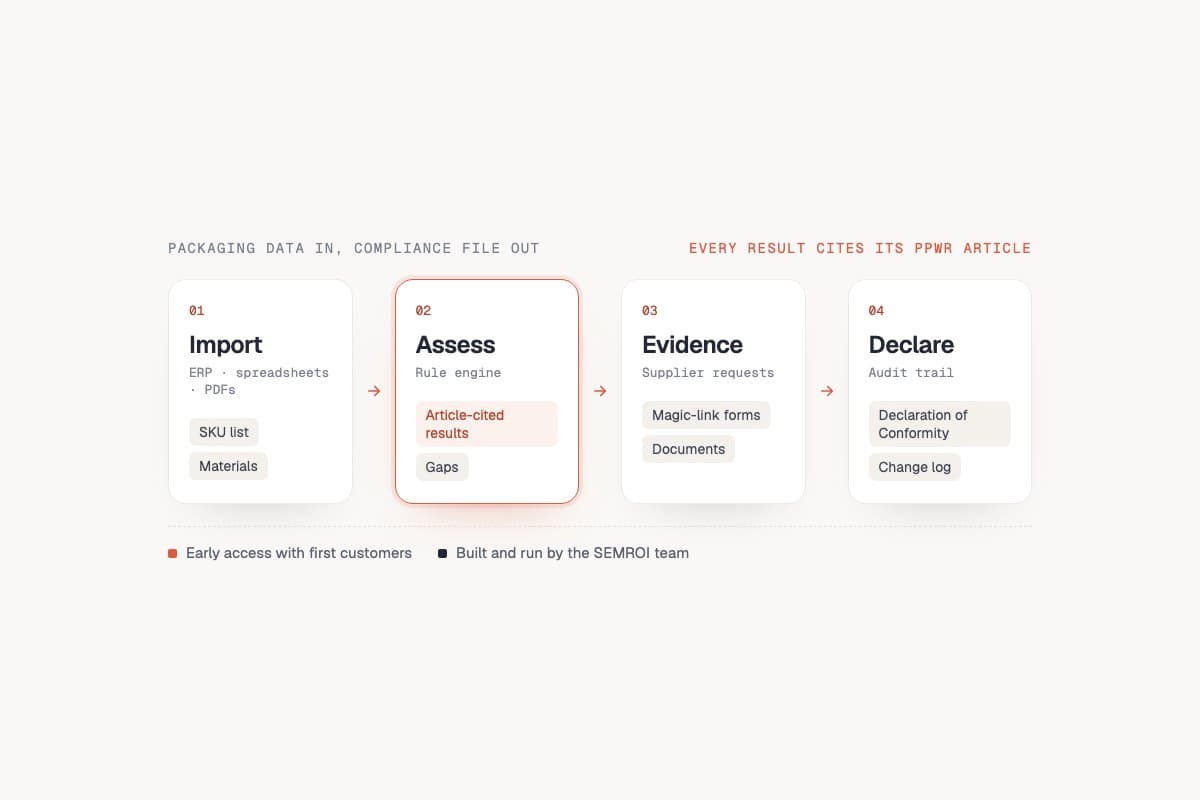
    • Built the platform on Next.js and TypeScript: a rule engine that ties every result to a PPWR article, supplier evidence requests and an audit trail.
    • Added CarbonormAI, an assistant that reads uploaded spreadsheets and PDFs and answers through the same rule engine.
    • Designed the website and CMS around buyer questions, with a free checklist and self-assessment tool.

    OutcomeOne product, one source of rules behind every screen.

  6. Go-to-marketNow

    From trade fair conversations to proposals

    • Free tools bring in leads from sustainability and compliance roles.
    • A first design partner, an electrical equipment manufacturer, shapes the product with us.
    • Trade fair and outbound work in Turkey, Romania and the DACH region.

    OutcomeA first design partner, and three companies evaluating a proposal.

Product stagesConcept → today
01ConceptResearch

A broad sustainability reporting idea

  • Started under a working title as a carbon and ESG reporting concept covering several frameworks.
  • Mapped existing tools screen by screen to see where they stopped short for manufacturers.

OutcomeA clear view of where the market was crowded.

02DiscoveryPersonas & market

Three buyers, one urgent problem

  • Built personas for the sustainability manager, the plant manager and the CFO.
  • Sized the market and tested pricing models against what each persona would sign off on.

OutcomePackaging compliance came out as the most urgent need.

03FocusScope decision

One regulation, done properly

  • Dropped the dual-regulation version of the product before writing production code.
  • Kept carbon reporting as a later direction, not part of the launch scope.

OutcomeA scope a small team can build and defend.

04Name & brandIdentity

A name tested in five languages

  • Scored name candidates for pronunciation in English, German, Turkish, Romanian and French, and for domain availability.
  • Built a brand system with its own palette, type, voice and tone rules, separate from the parent brand.

Outcomecarbonorm, with a calm and precise voice.

05Platform & websiteBuild

A rule engine, an AI assistant and a site

  • Built the platform on Next.js and TypeScript: a rule engine that ties every result to a PPWR article, supplier evidence requests and an audit trail.
  • Added CarbonormAI, an assistant that reads uploaded spreadsheets and PDFs and answers through the same rule engine.
  • Designed the website and CMS around buyer questions, with a free checklist and self-assessment tool.

OutcomeOne product, one source of rules behind every screen.

06Go-to-marketNow

From trade fair conversations to proposals

  • Free tools bring in leads from sustainability and compliance roles.
  • A first design partner, an electrical equipment manufacturer, shapes the product with us.
  • Trade fair and outbound work in Turkey, Romania and the DACH region.

OutcomeA first design partner, and three companies evaluating a proposal.

How we work

Every input passes through the product layer

Ideas come from the regulation, customers, partners and competitors. None goes straight to the build: each is checked, decided and given an owner first.

Comes in from
  • Regulation text
  • Customer interviews
  • Design partner
  • Competitor products
  • Investor feedback
Product layer · SEMROI
  1. Check the source
  2. Decide the scope
  3. Assign an owner
Goes to
  • Rule enginea new or changed rule, with its article
  • Brand & sitecopy, pages, free tools
  • Roadmapprioritised against the next release
  • Parkedlogged with the reason it waits

The same routine runs for client products: one register, one owner per item, a source for every claim.

One team, every layer

Strategy to platform, from one team

In most startups these layers sit with different agencies, and the gaps cost time. Here one team owns them all, so a decision reaches every layer the same week.

  • Brand
  • Website & CMS
  • Platform
  • CarbonormAI
Discovery · design · engineering · content
  1. One source of rules

    The rule engine behind the platform also answers in the AI assistant and the free self-assessment, so all three say the same thing.

  2. Brand written into the product

    The tone rules that shape the website also shape interface text and reports. No separate voice for marketing and product.

  3. Marketing that measures

    Free tools double as lead sources and as research: what visitors ask tells us what to build next.

  4. Lessons go to clients

    What we learn running our own product goes into the briefs and roadmaps we write for client products.

Before & after

From idea to product

AreaConcept stageNow
ScopeSeveral sustainability frameworks at onceOne regulation, covered in depth
BuyerAnyone with a reporting dutyMid-size and large manufacturers, food and beverage first
NameWorking titlescarbonorm, tested in five languages
ResultsReports written by handRule engine output, each result tied to an article
LeadsNoneFree checklist and self-assessment, trade fairs, outbound
Rule changesA new consulting projectA rule update with a public change logrolling out
  • Scope

    Now: One regulation, covered in depth

    Concept stage: Several sustainability frameworks at once

  • Buyer

    Now: Mid-size and large manufacturers, food and beverage first

    Concept stage: Anyone with a reporting duty

  • Name

    Now: carbonorm, tested in five languages

    Concept stage: Working titles

  • Results

    Now: Rule engine output, each result tied to an article

    Concept stage: Reports written by hand

  • Leads

    Now: Free checklist and self-assessment, trade fairs, outbound

    Concept stage: None

  • Rule changes

    Now: A rule update with a public change logrolling out

    Concept stage: A new consulting project

What we learned

  1. Cutting scope was the best decision we made

    Dropping half the original idea felt like a loss. It is the reason a small team could ship a product that holds up under a compliance buyer's questions.

  2. Every claim needs a source

    In a regulated market, one unsupported sentence costs more trust than ten good features earn. We hold our copy, our product and our AI to the same rule.

  3. Owning the risk changes the advice

    When the budget is our own, we stop recommending things that only look good in a proposal. Clients get the same discipline.

An idea or MVP that needs to become a product?

Tell us what you are building and where it is stuck. We'll show you what we would cut, what we would build first and how we would run it.

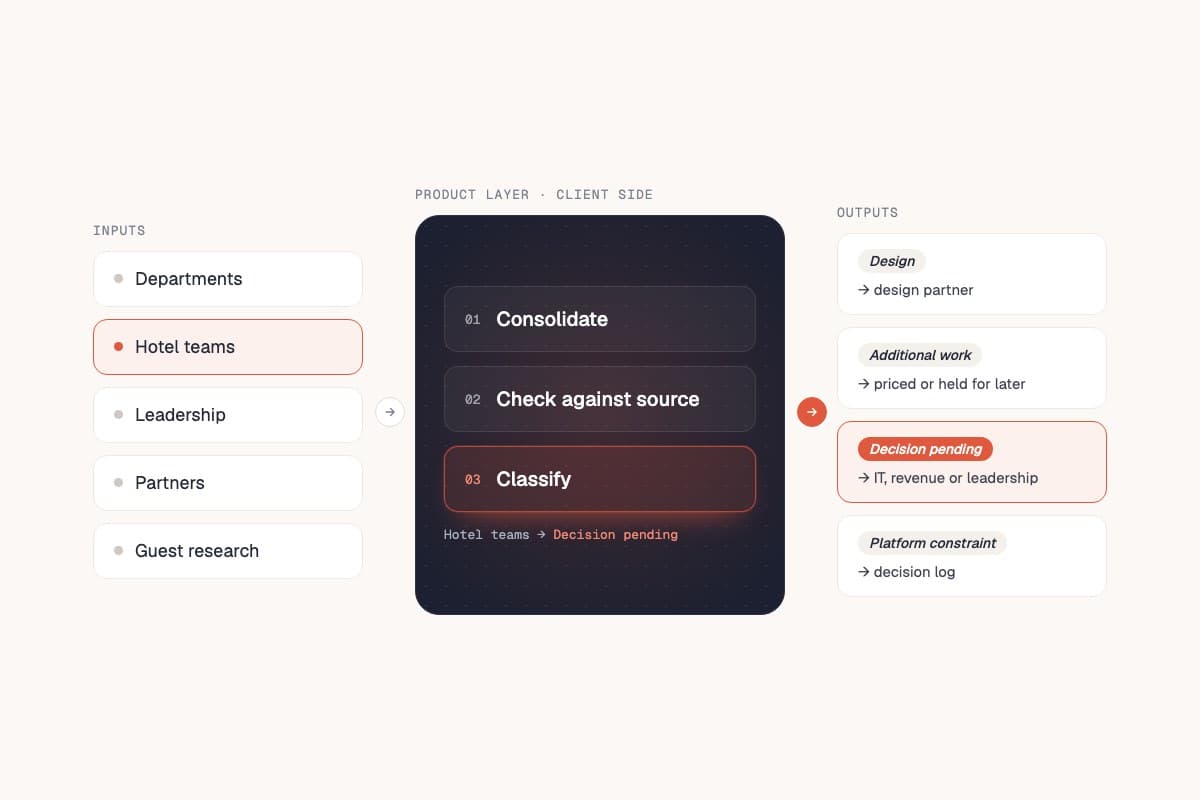
How every request reaches the partners: inputs, the client-side product layer, outputs
Next case study · Hospitality
A resort group's rebuild, run from the client's side