

Hotel website CRO (conversion rate optimization) is the work of turning more of the people who already visit your hotel website into direct bookings, without buying more traffic. It combines three things: the metrics that show where bookings are lost, the design and content rules that remove friction, and a test-and-learn process that keeps improving the site.
This guide brings our three hotel CRO articles together: what CRO means for a hotel website, the 9 metrics to track, funnel analysis and A/B testing, the 7 rules that high-converting hotel websites share, how to improve each metric, and how to run CRO as an ongoing process, with AI where it helps.
What Is Hotel Website CRO?
Conversion Rate Optimization (CRO) is the systematic set of improvements made to increase the rate at which a website’s visitors take a desired action (for example, making a booking, filling out a contact form, or requesting a quote). CRO enhances every interaction on your website, turning potential customers into actual ones.
When an effective CRO strategy is implemented on hotel websites:
- Booking Rates Increase: Optimizing the user experience raises the likelihood of bookings.
- User Satisfaction Increases: A smooth and intuitive experience builds customer trust and loyalty.
- Revenue Increases: Higher conversion rates directly contribute to revenue growth and improved financial performance.
9 CRO Metrics Every Hotel Website Should Track
To increase your hotel’s digital conversion rate, you need to know which metrics to track on your website. Below, you’ll find the most important CRO metrics and how to calculate them.
1. Booking Conversion Rate (Reservation Conversion Rate)
The Booking Conversion Rate measures the percentage of users who visit a room page and complete a booking. A low conversion rate may indicate user experience issues or obstacles in the booking process.
Booking CR (%) = (Total Number of Bookings / Room Page Views) × 100Example: A room page receives 20,000 views per month and generates 500 bookings. (500 / 20,000) × 100 = 2.5%
2. Bounce Rate
The Bounce Rate measures the percentage of visitors who leave the website without taking any action. A high bounce rate may indicate that the content does not meet user expectations or that the page loads too slowly.
Bounce Rate (%) = (Number of Users Who Leave Immediately / Total Visitors) × 100Example: A website receives 50,000 visitors, and 25,000 leave without interacting. (25,000 / 50,000) × 100 = 50%
3. Average Booking Value (ABV)
The Average Booking Value (ABV) represents the average revenue generated per booking. This metric helps optimize revenue management strategies.
ABV = Total Revenue / Total Number of BookingsExample: A hotel receives 1,000 bookings per month and generates $200,000 in total revenue. 200,000 / 1,000 = $200
4. Mobile vs. Desktop Conversion Rate
The Mobile vs. Desktop Conversion Rate compares the booking rates of mobile and desktop users to determine which device performs better.
CR (%) = (Total Number of Bookings / Device-Specific Visitors) × 100Example: Mobile: 30,000 visitors, 600 bookings → (600 / 30,000) × 100 = 2%
Desktop: 20,000 visitors, 800 bookings → (800 / 20,000) × 100 = 4%
If the mobile conversion rate is low, it may indicate issues with user experience or the payment process.
5. Exit Rate
The Exit Rate analyzes which pages users leave the website from most frequently. A high exit rate on critical pages—especially in the booking process—may indicate that users are struggling at these steps.
Exit Rate (%) = (Number of Users Exiting a Specific Page / Total Users Viewing That Page) × 100Example: Payment Page: 5,000 users view the page, and 2,000 users exit. (2,000 / 5,000) × 100 = 40%
6. Click-Through Rate (CTR)
Click-Through Rate (CTR) measures how effective reservation buttons or promotional links are. It indicates how much interest users show in the offers and call-to-action elements on your website.
CTR (%) = (Number of Clicks / Number of Impressions) × 100Example: Reservation Button: Displayed 10,000 times and receives 500 clicks. (500 / 10,000) × 100 = 5%
7. Time on Site (Average Time Spent)
Time on Site measures how long users stay on your website on average. Longer durations indicate engaging content, while very short durations suggest users may not be finding what they are looking for.
Average Time (minutes) = Total Time Spent (minutes) / Total Number of UsersExample: Website Traffic: 50,000 visitors spend a total of 150,000 minutes on the site. 150,000 / 50,000 = 3 minutes
8. Pages Per Session
Pages Per Session measures how many pages a visitor browses during a single session on your website. Higher numbers indicate strong user engagement, while lower numbers may suggest content or navigation issues.
Pages Per Session = Total Page Views / Total SessionsExample: Website Analytics: 200,000 page views across 50,000 sessions. 200,000 / 50,000 = 4 pages per session
9. Cart Abandonment Rate
Cart Abandonment Rate measures the percentage of users who start the booking process but leave before completing the reservation.
A high abandonment rate indicates friction in the payment steps, such as complicated forms, unexpected fees, or trust concerns.
Cart Abandonment Rate (%) = ((Users Who Reach the Payment Step − Users Who Complete the Booking) / Users Who Reach the Payment Step) × 100Example: Payment Page: 5,000 users reach the page, but only 3,000 complete the booking. ((5,000 − 3,000) / 5,000) × 100 = 40%
- Booking Conversion Rate: 500 bookings from 20,000 room page views
- 2.5%
- Bounce Rate: 25,000 of 50,000 visitors leave without interacting
- 50%
- Average Booking Value: $200,000 revenue from 1,000 bookings
- $200
- Mobile conversion rate: 600 bookings from 30,000 visitors
- 2%
- Desktop conversion rate: 800 bookings from 20,000 visitors
- 4%
- Exit Rate on the payment page: 2,000 of 5,000 users exit
- 40%
- Reservation button CTR: 500 clicks from 10,000 impressions
- 5%
- Average time on site: 150,000 minutes across 50,000 visitors
- 3 min
- Pages per session: 200,000 page views across 50,000 sessions
- 4
- Cart Abandonment Rate: 5,000 reach payment, only 3,000 book
- 40%
Funnel Analysis and A/B Testing
In addition to basic metrics, tracking advanced CRO metrics is essential for a deeper analysis of your hotel website’s conversion rate. Funnel Analysis and A/B Testing help you understand user behavior and identify the best strategies to optimize conversions.
1. Funnel Analysis
Funnel analysis identifies drop-off points in the booking process, showing where improvements are needed.
Typical Funnel Steps for Hotel Websites:
- Step 1Homepage
The user enters the website.
- Step 2Room Selection Page
The user views room details.
- Step 3Payment Page
The user proceeds to complete the booking.
- Step 4Booking Confirmation
The user successfully completes the reservation.
Funnel Step Conversion Rate (%) = (Users Proceeding to the Next Step / Users at the Current Step) × 100Example Calculation: Room Selection Page: 10,000 visitors; Payment Page: 4,000 visitors. (4,000 / 10,000) × 100 = 40%
Solutions:
- Identify factors preventing users from proceeding to the next step.
- Remove unnecessary form fields that discourage users.
- Offer more flexible payment options.
- Highlight trust elements (SSL certificates, customer reviews, secure payment icons, etc.).
2. A/B Testing Results
A/B testing compares two different versions of a design or content to measure their impact on conversion rates, helping to determine the most effective option.
How It Works:
- 50% of users see Version A (current design).
- 50% of users see Version B (new design).
- The version with the highest booking rate is implemented.
Conversion Increase (%) = ((B Version CR − A Version CR) / A Version CR) × 100Hotel Example: A Version (Old Design): 2% conversion rate; B Version (New Design): 2.4% conversion rate. (2.4 − 2) / 2 × 100 = 20%
What Should You Test?
7 Rules for a Hotel Website That Converts
Metrics show where bookings are lost. The seven rules below are the fixes we see work most often on hotel websites, from mobile design to tracking.
1. A Modern, Mobile-Friendly Hotel Website Design
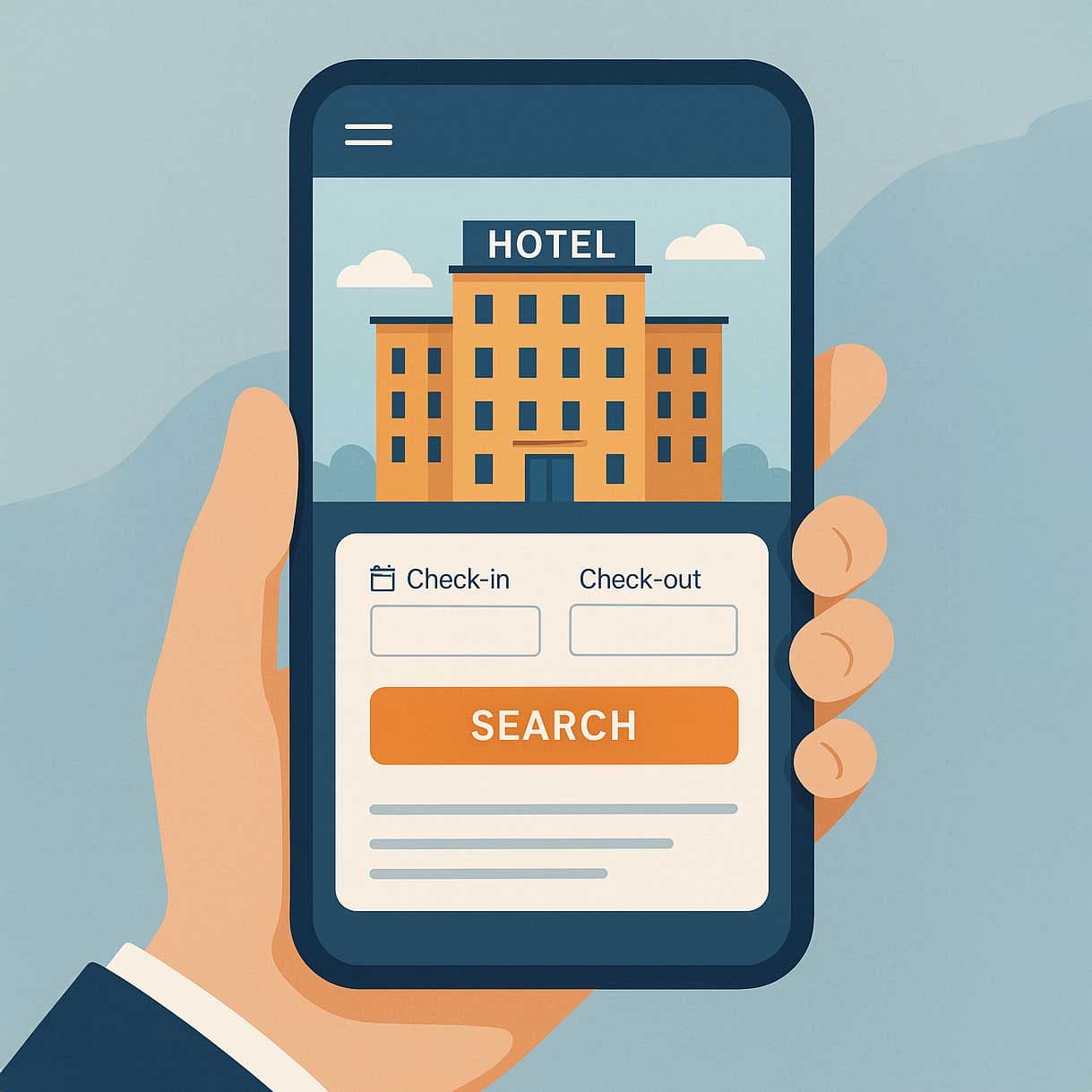
Today, most travel planning happens on smartphones. Travelers search for hotels, compare options and form their first impression through a mobile screen. If your hotel website loads slowly, is hard to navigate or makes the booking process complicated, the user experience is disrupted and potential guests may choose another hotel.
Being mobile-friendly is no longer optional. It’s a basic requirement that affects both how guests interact with your site and how Google ranks it.
To meet modern expectations, a mobile-friendly hotel website should:
- Load quickly and run smoothly on all devices including phones, tablets and desktops
- Reflect the hotel’s brand, audience and location with a consistent and appealing visual style
- Offer a clear layout with simple menus and visible booking buttons that support a smooth user experience
- Use high-quality images that are optimized for fast loading without slowing down the page
With Google’s mobile-first indexing, mobile performance is now critical for both user satisfaction and search engine visibility. A well-optimized mobile hotel website keeps visitors on your page longer and leads to more direct bookings.
A traveler from Istanbul finds your boutique beach hotel in Antalya on their phone. If the homepage loads slowly, the menu is disorganized or the booking button is hard to find, they leave. That lost first impression becomes a lost booking.
Suggestions by Hotel Type
- Hotel type: Luxury hotelsMobile suggestion: A clean and elegant mobile interface, with high-resolution images and smooth visuals that enhance the sense of prestige.
- Hotel type: Boutique hotelsMobile suggestion: Use warm colors, focus on room highlights and make the booking module easy to access.
- Hotel type: City hotelsMobile suggestion: Often have high booking traffic, so need fast-loading mobile pages and a simplified user flow to handle frequent reservations effectively.
| Hotel type | Mobile suggestion |
|---|---|
| Luxury hotels | A clean and elegant mobile interface, with high-resolution images and smooth visuals that enhance the sense of prestige. |
| Boutique hotels | Use warm colors, focus on room highlights and make the booking module easy to access. |
| City hotels | Often have high booking traffic, so need fast-loading mobile pages and a simplified user flow to handle frequent reservations effectively. |
2. A User-Friendly Booking System
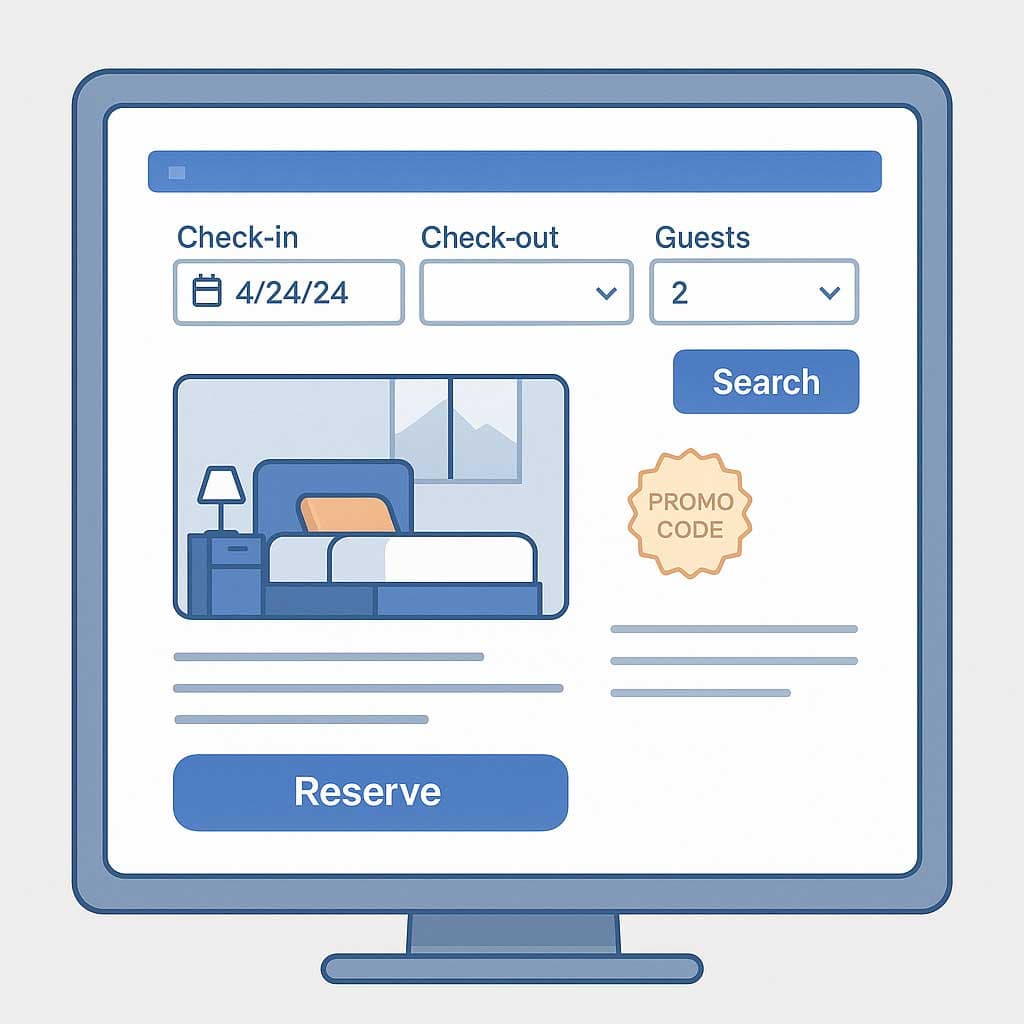
When a guest visits your hotel website, they’re looking for one thing above all: clarity. They want to find available dates, accurate prices and a booking process that takes just a few simple steps. If your booking engine is slow, confusing or doesn’t feel secure, there’s a high chance they will leave and book elsewhere.
A user-friendly booking system is more than just a technical feature. It’s a strategic part of your revenue model and plays a direct role in increasing bookings.
To create a strong booking experience, keep these essentials in mind:
- Simple and clear booking steps. Guests should be able to choose dates, select the number of people and view room details on a single page
- Real-time availability. Room availability and pricing should update instantly to reflect current conditions
- Promo code and special offer fields. These encourage loyalty and make direct booking more attractive
Secure payment integration. Clearly display trusted features like 3D Secure, SSL certificates and reliable payment gateways
Multi-language and multi-currency support. This is key for international guests who expect localized booking options
A guest from Berlin visits your site. It automatically shows German content, prices in euros and a visible promo code field, and booking takes less than two minutes. This builds trust and starts a positive relationship with your brand.
Language and Location-Based Experience
For destinations like Antalya, Istanbul and Cappadocia, which attract international travelers, having a hotel website that automatically adjusts language and currency based on the user’s location can significantly increase direct booking rates.
3. High-Quality Visual and Video Content
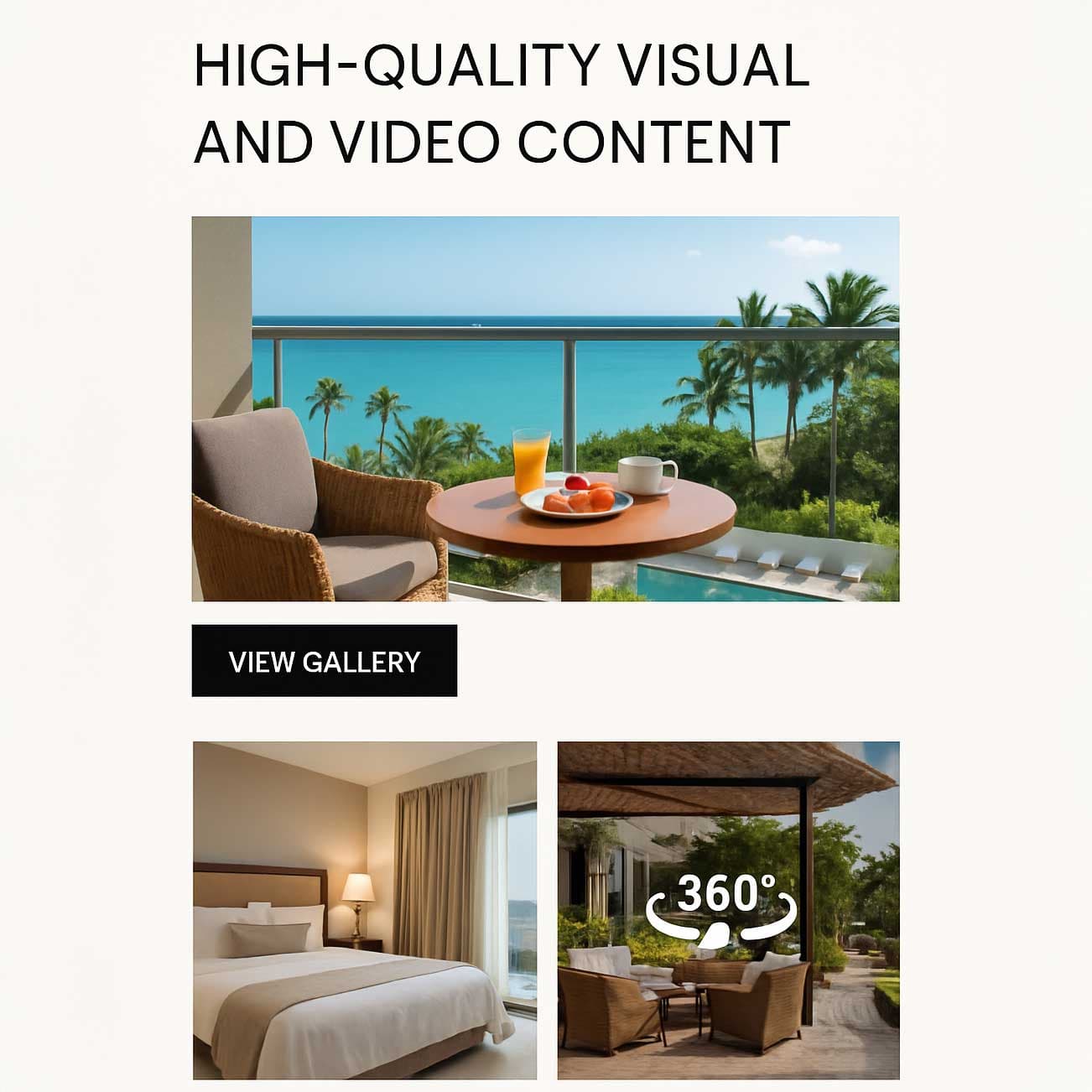
Before guests experience your hotel in person, they visit your website. In most cases, their first impression is shaped by the visuals. Clear, professional and emotionally engaging images don’t just inform — they influence, convince and guide visitors toward booking.
Visual content is one of the strongest tools to reflect the soul of your hotel.
It doesn’t just show the space, it communicates the experience.
To use visual and video content effectively on your hotel website, consider the following:
- High-resolution professional photos: Showcase rooms, the pool, restaurant, spa and outdoor areas with sharp, detailed images.
- 360-degree virtual tours or promotional videos: These are powerful and interactive tools that allow users to explore the hotel’s atmosphere online.
- Visual consistency: Maintain harmony in color tones, lighting and shooting angles to create a polished and unified look.
- Optimized sliders and galleries: Avoid oversized homepage sliders that slow down the website. Keep galleries clean and quick to load.
- Emotion-driven storytelling: Choose visuals that show the experience, not just the setting — like dinner at sunset or happy family moments by the pool.
In addition to professional visuals, user-generated content such as guest-shared photos or experience videos builds credibility. Featuring your hotel’s sustainability practices or social responsibility efforts also adds meaningful value to your brand.
Make sure to update your visual content regularly. Quality visuals are not just about aesthetics, they shape the perception of your professionalism. Poor visuals can create doubt, while well-prepared galleries build trust and support direct bookings.
4. SEO and GEO-Optimized Structure
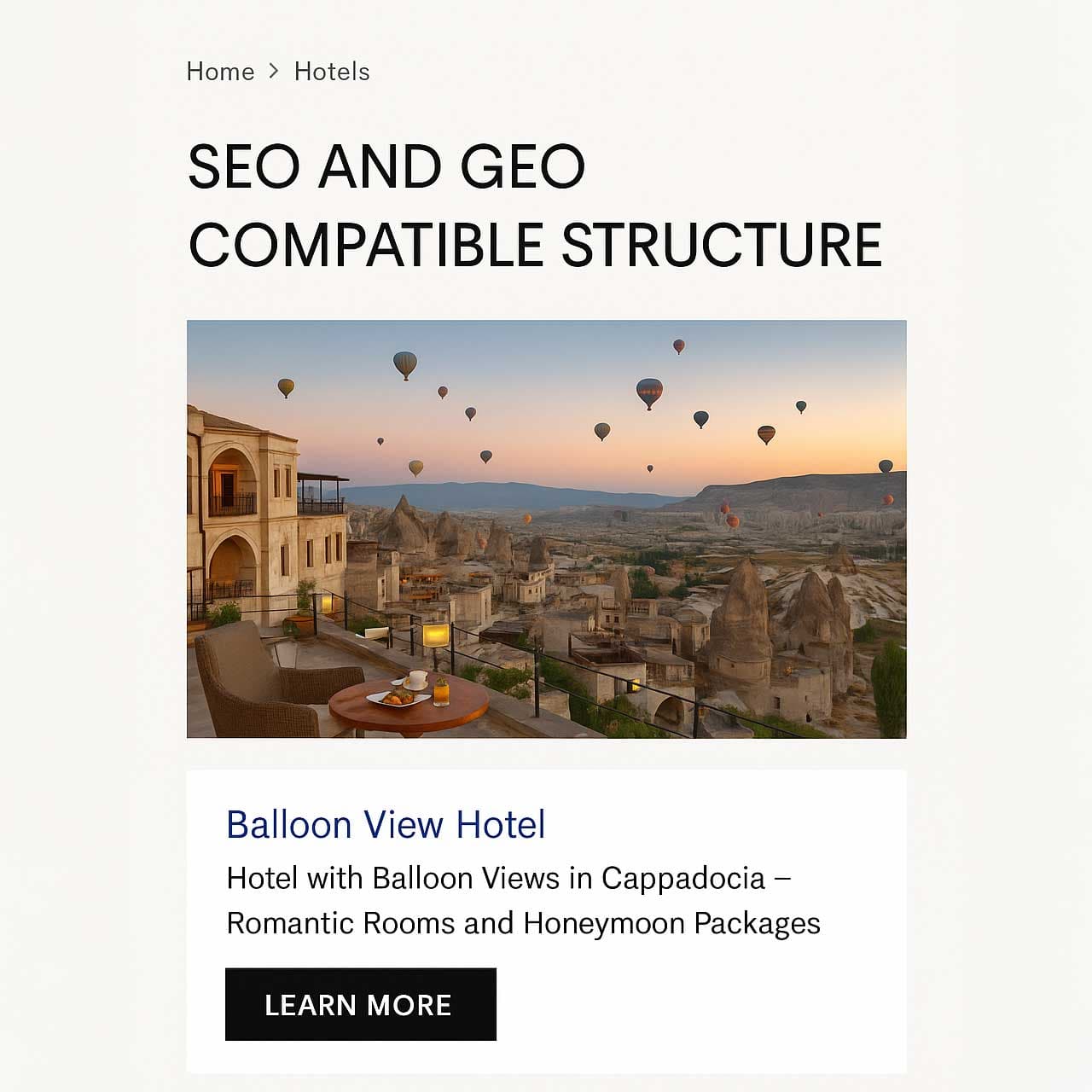
The visibility of your website is no longer limited to search engines like Google or Yandex. Today, users also turn to AI-powered platforms such as ChatGPT, Gemini and others for travel and accommodation recommendations. That’s why your content must be optimized not only for traditional SEO but also for GEO (Generative Engine Optimization).
To ensure your hotel website is visible on both search engines and AI platforms, consider the following:
Local SEO efforts make your hotel more visible in regional searches. Creating content that matches specific queries like “seafront hotel in Lara, Antalya” is essential. Additionally, FAQ sections written in natural language help you appear in voice search results and AI recommendations.
SEO is no longer just about ranking on the first page of Google. Your website content should also be optimized to appear as a trusted source in AI-based conversational tools. This requires attention to both technical structure and language style.
A user in Germany asks ChatGPT for a romantic Cappadocia hotel with balloon views. If your SEO- and GEO-optimized pages cover “hot air balloon view rooms in Cappadocia” or “honeymoon packages”, AI systems can recommend your hotel directly.
The same user may then search on Google for “Cappadocia hotel with balloon views”. Thanks to well-structured page titles, meta descriptions and relevant local content, your hotel is more likely to appear among the top organic search results.
Conclusion: Your hotel website becomes visible both in traditional search engines and AI-driven platforms, greatly increasing your chances of getting direct bookings.
Being featured on AI recommendation platforms is important, but providing AI-powered assistants directly on your hotel website is also becoming part of digital transformation. To learn more, check out our content on how Hotel AI Agent technology can benefit your property.
5. Trust Elements and Social Proof
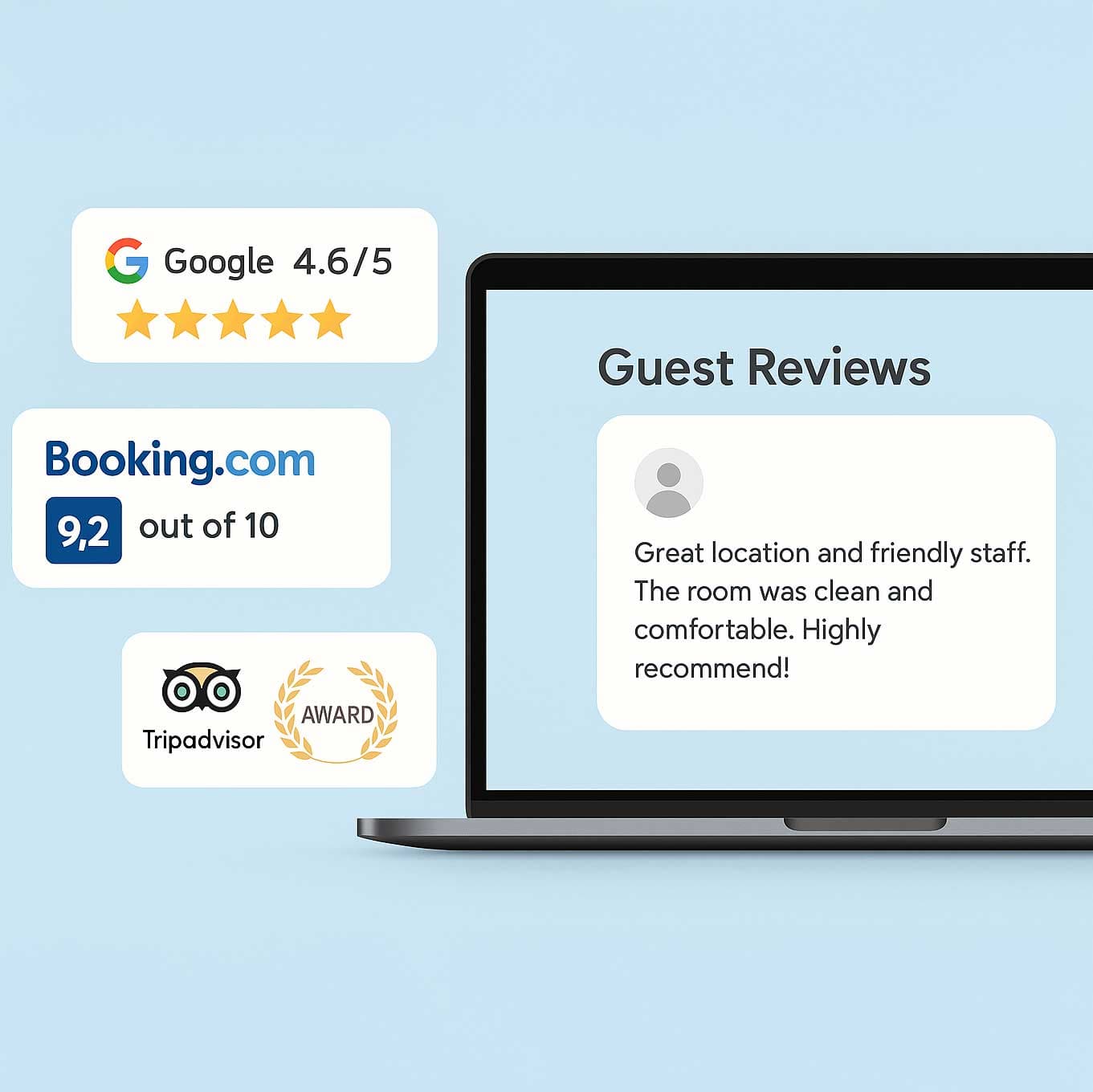
No matter how stylish a hotel website may look, users often place their trust in guest reviews and ratings from independent sources. Trust elements are digital signals that reassure potential customers and help them make faster booking decisions.
To build trust, your hotel website should include the following:
Your site should also visibly display SSL certificates, secure payment logos and third-party security badges. A live chat function adds another layer of trust by offering instant support. During crisis periods (such as pandemics or natural disasters), adding quick-access pages for policies and updates helps reassure guests.
These elements do more than just build trust. They show that your brand is authentic, approachable and connected to real guests.
Example Scenario: A user from the UK visits your website and sees a section titled “What Our Guests Say.” The page includes verified, dated guest reviews, a Google rating and a high Booking.com score such as 9.2 out of 10. A TripAdvisor certificate and award badge are also displayed. Reassured by this social proof, the user feels confident and completes their reservation directly through your site without looking elsewhere.
6. Multi-Language and Multi-Currency Support
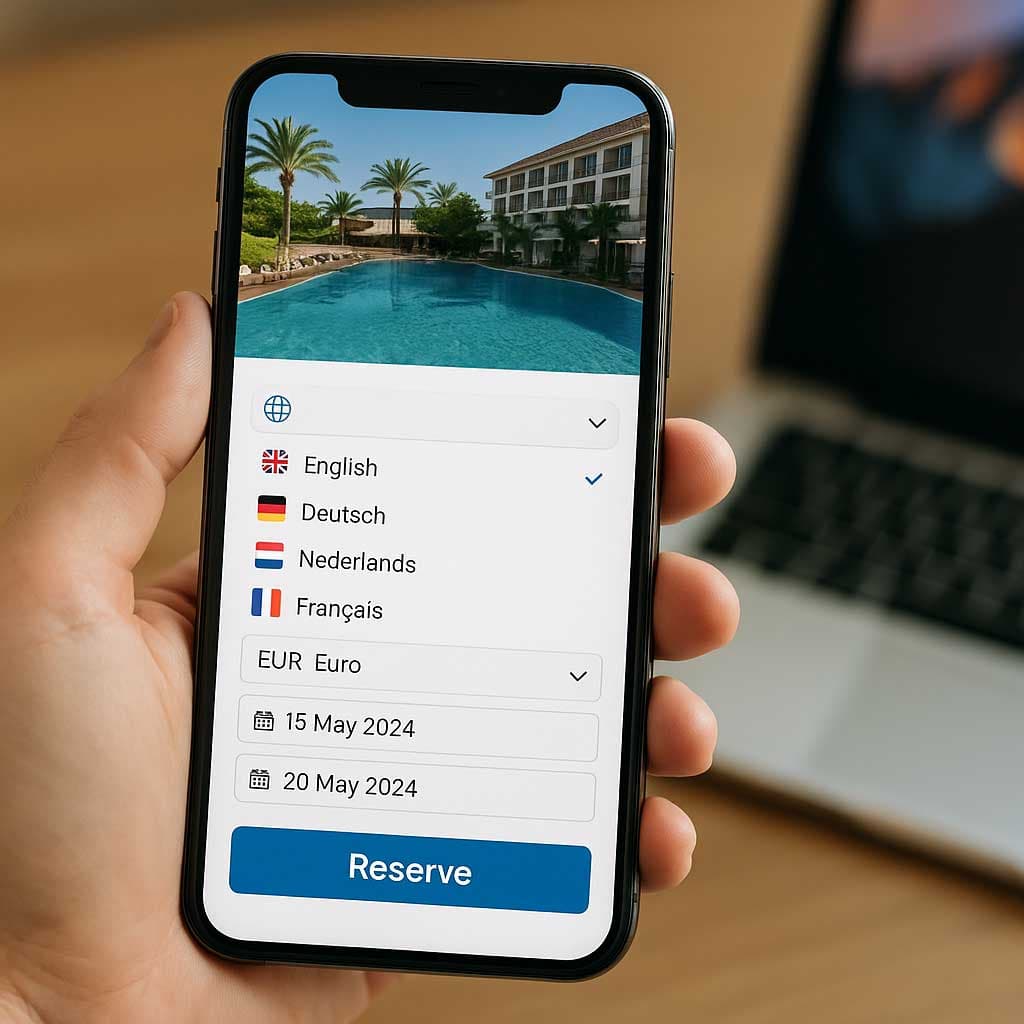
If your hotel welcomes international guests, having a website available only in Turkish is a major disadvantage. When users cannot access information in their own language, their sense of trust decreases, and the chance of booking drops significantly.
Multi-language and multi-currency support makes the user experience more inclusive and simplifies the booking process.
Advantages of implementing multi-language and multi-currency infrastructure on your hotel website:
- Automatic language detection based on browser settings: The visitor’s language should be recognized instantly upon entering the site, with an option for manual selection if needed.
- Professional translations for the most common languages: Content should be smooth and user-friendly in key languages such as English, German, Russian and Arabic.
- Currency selection: Displaying prices in popular currencies like Euro, Dollar or Pound builds trust, especially during the payment stage.
- Price locking and automatic currency conversion: No matter which currency the user selects, there should be no hidden fees or exchange rate surprises.
- Localized booking process: Calendar formats, date displays and payment methods should be adjusted to match user preferences and habits.
Beyond multilingual infrastructure, cultural adaptation is equally important. The colors, visuals and messages used in your content should align with the expectations of users from different regions. Paying attention to accessibility standards like ADA (Americans with Disabilities Act) compliance also shows that your hotel values inclusion in the digital space.
Relying only on a Google Translate plugin is not enough. For core languages like English and German, use content written or reviewed by native speakers. It feels more natural and improves your visibility on AI-powered search platforms.
Example Scenario: A user from the Netherlands searches for your hotel in Antalya using a mobile device. The website automatically switches to English, prices are displayed in Euros and the visitor is welcomed by a headline like “All inclusive family hotel in Antalya.” Throughout the booking process, everything — from time format to currency and calendar layout — is localized.
Result: The user feels completely comfortable at every step and completes the direct booking on your hotel website without hesitation.
7. Digital Marketing and Tracking Infrastructure
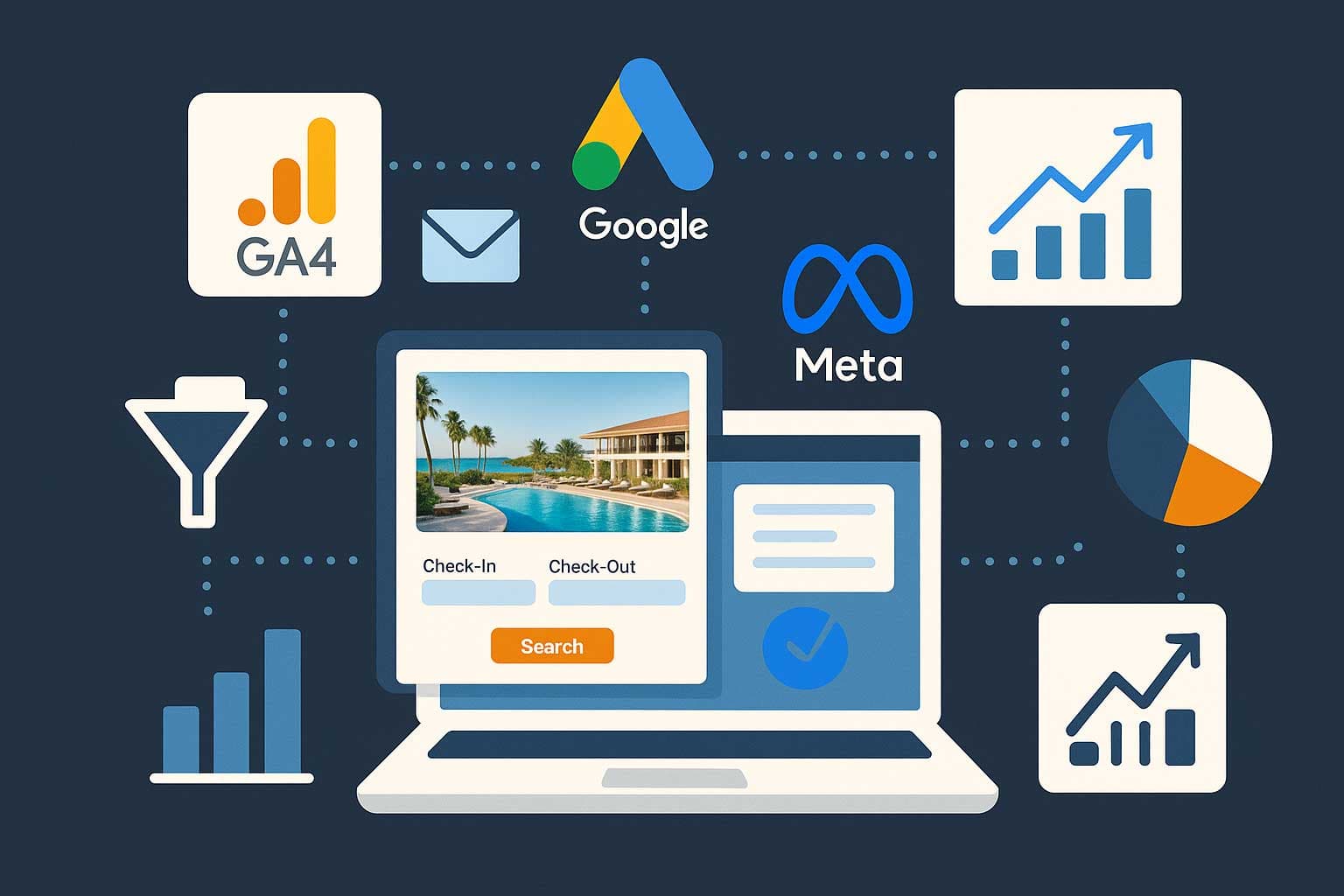
An eye-catching design helps attract visitors, but to understand where conversions actually happen, a strong technical foundation is essential.
A well-structured digital marketing and analytics setup shows you what works, which pages drive bookings and how your advertising budget is being spent.
Core digital infrastructures that every hotel website should have:
- Tool: Google Analytics 4 (GA4)What it does: Allows you to track user behavior on your site and analyze the paths that lead to bookings.
- Tool: Meta Pixel and Google Ads conversion tagsWhat it does: Help measure how much of your ad traffic results in actual bookings.
- Tool: Heatmap tools like Hotjar or ClarityWhat it does: Show where users click and where they get stuck, helping you improve user experience (UX).
- Tool: Centralized control with Tag ManagerWhat it does: Manage all tracking codes in one place, keeping your website flexible and easy to update.
- Tool: Email marketing integration (Mailchimp, etc.)What it does: Essential for newsletter subscriptions, campaign announcements and direct sales communication.
- Tool: A/B testingWhat it does: Traffic data alone isn’t enough. Test which headlines or elements drive more clicks and engagement.
| Tool | What it does |
|---|---|
| Google Analytics 4 (GA4) | Allows you to track user behavior on your site and analyze the paths that lead to bookings. |
| Meta Pixel and Google Ads conversion tags | Help measure how much of your ad traffic results in actual bookings. |
| Heatmap tools like Hotjar or Clarity | Show where users click and where they get stuck, helping you improve user experience (UX). |
| Centralized control with Tag Manager | Manage all tracking codes in one place, keeping your website flexible and easy to update. |
| Email marketing integration (Mailchimp, etc.) | Essential for newsletter subscriptions, campaign announcements and direct sales communication. |
| A/B testing | Traffic data alone isn’t enough. Test which headlines or elements drive more clicks and engagement. |
CRM integration simplifies post-booking communication. Funnel analysis shows where users drop off, helping you continuously optimize conversion rates.
If you want to analyze your booking conversion data reliably with GA4, your tracking setup must be correctly configured. To avoid data loss at any stage of the booking process and to accurately measure marketing performance, check out our step-by-step guide to Google Analytics 4 Conversion Tracking.
Tip: A technically strong website goes beyond speed. Use AMP (Accelerated Mobile Pages) for ultra-fast mobile page loading. Run cross-device tests to ensure the booking process works smoothly on all screens. Offer a variety of payment options (bank cards, Apple Pay, PayPal, etc.) to meet the preferences of different user segments.
Example Scenario: You run an ad campaign that drives traffic to your hotel website from Instagram. Visitors land on the booking page, but 70% abandon the process. Using GA4 and Hotjar, you discover that the page slows down after users select their dates. You optimize the form, improve the loading speed and see a 15% increase in conversion rate.
Improvements driven by data directly increase your revenue.
How to Improve Hotel Website Conversion Rate
To increase the booking rate on your hotel website, you should regularly analyze CRO metrics and apply conversion optimization strategies. By improving critical metrics such as Booking Conversion Rate, Bounce Rate, Funnel Analysis, and A/B Testing, you can convert more visitors into bookings. Here are effective optimization methods for each metric:
1. How to Increase Booking Conversion Rate?
- Simplify the booking process. Remove unnecessary steps to allow users to complete their reservations quickly.
- Highlight trust elements. Display SSL certificates, customer reviews, and secure payment options.
- Offer promotions and discounts. Create incentives such as “Early Booking Deals” or “Last-Minute Discounts.”
- Use clear and compelling calls to action (CTA). Make “Book Now” buttons visible and attention-grabbing.
2. How to Reduce Bounce Rate?
- Improve page speed. Use tools like Google PageSpeed Insights to optimize slow-loading pages.
- Enhance mobile compatibility. Ensure your website works seamlessly across all devices.
- Align content with visitor expectations. Optimize SEO with the right keywords.
- Use engaging visuals and clear content. Create high-quality content that keeps visitors on the site longer.
3. How to Increase Average Booking Value (ABV)?
- Offer room upgrade (upsell) options. Show users upgrade offers for more comfortable or scenic rooms during the booking process.
- Provide additional services. Offer extras such as breakfast, airport transfers, or private tour packages.
- Create package deals. Increase the average booking value by providing offers like “Stay 3 Nights + Free Spa Access.”
4. How to Improve Mobile and Desktop Conversion Rates?
- Develop a mobile-optimized interface. Create a booking flow that works better on smaller screens.
- Provide fast and easy payment options. Offer secure and convenient payment methods such as credit/debit cards, digital wallets, and alternative payment options. Minimize steps in the payment process to increase conversions.
- Launch mobile-exclusive promotions. Increase mobile conversions with offers like “Exclusive 5% Discount for Mobile Users.”
5. Reduce User Drop-off with Funnel Analysis
- Simplify the payment page. Remove unnecessary form fields that users must fill out.
- Add a step-by-step guide. Use a progress bar to show users which stage of the booking process they are in.
- Retarget users who are about to exit. Encourage reservations with pop-ups like “Don’t miss this deal!”
6. Improve Performance with A/B Testing
- Test booking buttons. Experiment with different colors, sizes, and text to determine which gets more clicks.
- Try different pricing strategies. Test variations like “Hide Price” or “Show Discounted Price.”
- Compare page layouts. Measure how different reservation page designs affect conversion rates.
CRO Implementation Steps for Hotel Websites
Boosting conversion rates on hotel websites requires a systematic, data-driven approach. This process begins with a thorough assessment of your site’s current performance and continues with targeted improvements that enhance the user experience. Below are the key phases:
- Step 1Assessment and Goal Setting
Performance Analysis · Defining the Target Audience · Establishing KPIs
- Step 2Testing and Experimentation
A/B Testing · Multivariate Testing · User Segmentation · Customer Feedback
- Step 3Technical Optimization Strategies
Page Speed and Mobile Compatibility · Navigation, Content, and Visual Layout · Reservation Form and Process Improvements
1. Assessment and Goal Setting
- Performance Analysis:
Review key CRO metrics such as visitor numbers, average session durations, and bounce rates-to pinpoint your website’s strengths and weaknesses. - Defining the Target Audience:
Analyze the profiles, needs, and expectations of your visitors to clearly identify which user segments to focus on. - Establishing KPIs:
Based on your analysis, set clear key performance indicators (KPIs) like conversion rate, click-through rate, and booking volume. These benchmarks will measure the success of your optimization efforts.
2. Testing and Experimentation
- A/B Testing:
Create two versions of specific elements (e.g., button colors or copy) and test them with randomized user groups to determine which version drives higher conversions. - Multivariate Testing:
Simultaneously test multiple elements to assess how different combinations impact user behavior, enabling you to identify the most effective design and content strategies. - User Segmentation:
Evaluate responses from various user groups to tailor your optimization strategies for each segment. - Customer Feedback:
Collect direct input from users to continuously refine and improve the site’s functionality and overall customer satisfaction.
3. Technical Optimization Strategies
- Page Speed and Mobile Compatibility:
Optimize your website for faster load times and ensure seamless performance on mobile devices. A quick, mobile-friendly site encourages users to stay longer and complete bookings. - Navigation, Content, and Visual Layout:
Structure intuitive navigation menus, clear calls-to-action (CTAs), and a user-friendly content layout. A clean, appealing design not only captures attention but also promotes engagement. - Reservation Form and Process Improvements:
Simplify the booking process by reducing form fields, integrating auto-fill options, and enhancing error handling. Streamlined forms reduce friction and lower abandonment rates.
Regularly review and update these steps based on performance data to continuously enhance the user experience, drive up conversion rates, and maintain a competitive edge in the digital marketplace.
Using AI in Hotel Website CRO
AI technologies add a new dimension to conversion rate optimization (CRO) strategies on hotel websites. By leveraging AI, user data is analyzed in depth, enabling the delivery of personalized experiences and real-time optimization adjustments. Here’s how AI integration enhances the CRO process for hotels:
Enhancing CRO with AI-Driven Insights
AI-powered systems sift through large volumes of data from hotel websites to identify which pages and content elements drive bookings. This objective analysis pinpoints weak areas and highlights where improvements are needed, allowing hotel managers to make informed decisions and allocate budgets more efficiently.
Advanced Analytics and Personalization
- Dynamic Content and Recommendation Engines: AI continuously monitors visitor behavior to deliver personalized content and offers in real time. This dynamic approach keeps users engaged and supports the booking process.
- Detailed User Segmentation: With AI, visitors are segmented into highly specific groups, enabling tailored strategies that communicate the right message to each audience segment.
- Predictive Analytics: By analyzing historical and current data, AI forecasts trends in user behavior and booking patterns. These insights allow hotels to proactively update strategies, enhancing their competitive edge.
AI-Powered Chatbots and Automated Customer Service
- 24/7 Customer Support:
AI-based chatbots offer instant, round-the-clock support, addressing visitor inquiries and providing essential information immediately. - Assisted Booking Process:
Integrated chatbots guide users through each step of the booking process, ensuring a faster and more seamless experience. - Natural Language Processing (NLP):
With robust NLP capabilities, AI accurately interprets user queries and provides effective solutions, boosting customer satisfaction and positively influencing the booking journey.
Continuous Booking Process Optimization
AI monitors user interactions on the website in real time to detect friction points. For instance, if users struggle with a specific form field, the system can quickly simplify the form or provide helpful tips.
AI-Driven User Segmentation and Future Forecasting
AI categorizes potential guests by shared characteristics, predicting future behaviors for each segment. This foresight enables hotels to deploy the right strategies at the right time, strengthening customer loyalty.
Groups like “honeymoon couples,” “business travelers,” or “families on vacation” can be targeted with customized campaigns and personalized content.
AI agents go one step further than chatbots: they can answer guest questions, check availability and complete bookings on the site. We cover how they work in What Is a Hotel AI Agent?.
Tools for Hotel Website CRO
Here are the best tools to analyze and improve your hotel website’s CRO metrics:
- Tool: Google Analytics 4Funnel & trackingWhat it does: The most effective tool for analyzing where users drop off in the conversion funnel.
- Tool: MixpanelFunnel & trackingWhat it does: Used for in-depth funnel analysis and understanding user behavior.
- Tool: Google OptimizeA/B testingWhat it does: Ideal for comparing conversion rates between different versions of a webpage.
- Tool: OptimizelyA/B testingWhat it does: Enables advanced A/B testing and multivariate testing.
- Tool: HotjarUser behaviorWhat it does: Provides heatmaps and session recordings to visualize user interactions on your website.
- Tool: Crazy EggUser behaviorWhat it does: Analyzes click patterns on your pages to help understand user behavior.
- Tool: Google PageSpeed InsightsSpeed & mobileWhat it does: Analyzes website speed and provides optimization recommendations.
- Tool: GTmetrixSpeed & mobileWhat it does: Offers detailed page load time insights and performance improvement suggestions.
- Tool: Ahrefs / SEMrushSEO & keywordsWhat it does: Analyzes your website’s SEO performance and identifies the best keywords.
- Tool: Google Search ConsoleSEO & keywordsWhat it does: Shows your website’s organic traffic performance and highlights technical SEO issues.
| Tool | What it does | Use for |
|---|---|---|
| Google Analytics 4 | The most effective tool for analyzing where users drop off in the conversion funnel. | Funnel & tracking |
| Mixpanel | Used for in-depth funnel analysis and understanding user behavior. | Funnel & tracking |
| Google Optimize | Ideal for comparing conversion rates between different versions of a webpage. | A/B testing |
| Optimizely | Enables advanced A/B testing and multivariate testing. | A/B testing |
| Hotjar | Provides heatmaps and session recordings to visualize user interactions on your website. | User behavior |
| Crazy Egg | Analyzes click patterns on your pages to help understand user behavior. | User behavior |
| Google PageSpeed Insights | Analyzes website speed and provides optimization recommendations. | Speed & mobile |
| GTmetrix | Offers detailed page load time insights and performance improvement suggestions. | Speed & mobile |
| Ahrefs / SEMrush | Analyzes your website’s SEO performance and identifies the best keywords. | SEO & keywords |
| Google Search Console | Shows your website’s organic traffic performance and highlights technical SEO issues. | SEO & keywords |
Conclusion: Every Visit Is a Booking Opportunity
A hotel website converts when it is fast on mobile, makes booking simple, shows the property honestly, earns trust and speaks the guest’s language. Metrics tell you which of these is failing; tests tell you which fix works.
Start with the booking conversion rate and the funnel step where most guests drop off. Fix that one step, measure again, and move to the next.
Hotel Website CRO: Frequently Asked Questions
What is CRO and why is it important for hotel websites?
CRO refers to the improvements made to a website to increase the percentage of visitors who become customers or complete a booking. For hotel websites, CRO focuses on boosting booking rates and enhancing the user experience, which leads to higher customer satisfaction and brand loyalty.CRO refers to the improvements made to a website to increase the percentage of visitors who become customers or complete a booking. For hotel websites, CRO focuses on boosting booking rates and enhancing the user experience, which leads to higher customer satisfaction and brand loyalty.
What steps should be taken when starting CRO for hotel websites?
Begin by analyzing your site’s traffic, exit rates, and booking process using tools like Google Analytics. Set measurable goals (e.g., a 20% increase in bookings or doubling mobile conversions) and focus on simplifying booking forms, ensuring fast page load times, and offering intuitive navigation.
Why is mobile compatibility critical for hotel websites?
Many online bookings are made via mobile devices. Mobile compatibility ensures users can easily access your site and complete transactions quickly. Slow-loading or poorly formatted pages can drive potential guests away, negatively impacting conversion rates.
What advantages does integrating AI with CRO offer for hotel websites?
AI delivers personalized experiences by providing dynamic content and tailored offers based on user behavior, increasing the likelihood of bookings. AI-powered chatbots offer round-the-clock support, and data-driven insights from AI help create more effective, targeted marketing strategies.
Which CRO tools are used to analyze user behavior on hotel websites?
Google Analytics: Tracks visitor traffic, conversion funnels, and page performance. Hotjar / Crazy Egg: Provide visual insights through heatmaps and session recordings to understand user behavior. SEMrush / Ahrefs: Used for competitor analysis, evaluating SEO performance, and conducting keyword research.
What should be considered when optimizing hotel reservation forms?
Request only essential information from users and include auto-fill options for fields like name and email to speed up the booking process. Enhance credibility by using SSL certificates, customer reviews, and trust badges.
What is the role of A/B testing in CRO?
A/B testing involves comparing two versions of a webpage or element (such as button color or copy) to determine which version yields a higher conversion rate. This data-driven approach helps guide improvements by identifying the most effective changes.
How is the success of CRO strategies measured?
Conversion Rate: The percentage of visitors who complete a booking. Bounce Rate: The percentage of visitors who leave after viewing only one page. Average Session Duration: How long visitors remain on your site. Specific KPIs: Such as the number of bookings, form completions, or email subscriptions.
What is the relationship between conversion rates and customer satisfaction?
High conversion rates generally indicate a strong user experience. Simple booking processes, fast-loading pages, and personalized recommendations boost customer satisfaction. Satisfied guests are more likely to rebook and leave positive reviews, enhancing both brand image and revenue.
What is a good conversion rate for a hotel website?
It depends on how you measure it and on your traffic mix, so the most useful benchmark is your own: track booking conversion rate (bookings ÷ room page views or sessions) by device and channel, and improve it month over month. A large gap between mobile and desktop is the most common sign of a fixable problem.
How can I improve my hotel website conversion rate quickly?
Shorten the booking flow, make the booking button visible on every room page, show the full price early, speed up the mobile site and add recent guest reviews. Then use funnel analysis to find the step where most guests leave and test a fix for that step first.
- Hotel
- CRO
- Conversion Rate Optimization